Radon Mitigation in Aspen, Colorado

Just opened a high radon result — or racing an inspection deadline? You're in the right place. About half of Colorado homes test high, and the Roaring Fork Valley is no exception. We're the licensed local crew who'll test your home, install the fix, and prove your number dropped with a verification test before we leave.

Call (970) 315-9807
Or get a free quote in 60 seconds
Colorado-Licensed (HB21-1195)
NRPP-Certified Methods
Verification Test Included
Aspen to Glenwood Springs

Get a Fast, Free Quote

Tell us about your home and a licensed pro will get right back to you — usually the same day. Prefer to talk it through? Call (970) 315-9807.

  • Straight answers first — we'll point you to a free county kit if that's all you need
  • A 48-hour verification test included on every install
  • Scheduling that works around real-estate objection deadlines

Radon Services for the Roaring Fork Valley

One team for the whole problem — testing, mitigation system design and installation, repairs, and the situations unique to mountain homes.

Radon Testing

Professional continuous-monitor tests for peace of mind or real-estate deadlines — and straight answers about the county's free kits.

Radon testing →

Mitigation Systems

Sub-slab depressurization, sump-pit systems, and quiet routing designed for how your home is actually built.

Mitigation systems →

Crawlspaces & Complex Foundations

Walkout basements, hillside homes, mixed slab-and-crawlspace footprints — the valley specialty nobody else explains.

Complex foundations →

Real-Estate Deadlines

Under contract with a high test and an objection deadline? Testing and mitigation on transaction timelines.

Real-estate radon →

Second Homes & Property Managers

Vacant-home testing done right, remote monitoring, and disclosure duties for landlords and STR operators.

Second homes →

Fan Replacement & Repair

Manometer reading zero? Fans last 10–15 years. We repair and replace systems and retest to prove they work.

Repairs →

Radon in Aspen: What the Numbers Actually Say

Radon is a naturally occurring radioactive gas — colorless, odorless, and tasteless — produced as uranium in rock and soil breaks down. The EPA classifies it as a Class A carcinogen: it's the second-leading cause of lung cancer in the United States and the number-one cause among people who have never smoked, linked to roughly 21,000 deaths a year.

Colorado sits near the top of the national risk map. The state health department's own headline is blunt: about half of Colorado homes have elevated radon. Locally it's the same story. Pitkin County is in EPA Zone 1 — the highest-risk designation — and county environmental health staff report that roughly 40–50% of homes tested in the Aspen area come back above the EPA action level of 4.0 pCi/L. Garfield County, down-valley, is also Zone 1 with about 40% of tests high. Eagle County is mapped Zone 2, but real-world testing shows roughly 40–45% of its homes exceed the action level anyway — the map is a prediction; your test is the truth.

None of this is new to Aspen. The city was the first municipality in Colorado to put radon requirements into its building code, back in 2003, and Pitkin County publishes maps of local test results and hands out free test kits every January. The local risk is documented, public, and taken seriously by the people who write our building codes. The only unknown is your house.

How Radon Mitigation Works

A mitigation system doesn't filter radon — it stops it from getting inside. The standard approach, sub-slab depressurization, creates gentle suction under your foundation so soil gas is collected below the house and vented above the roof, where it disperses harmlessly.
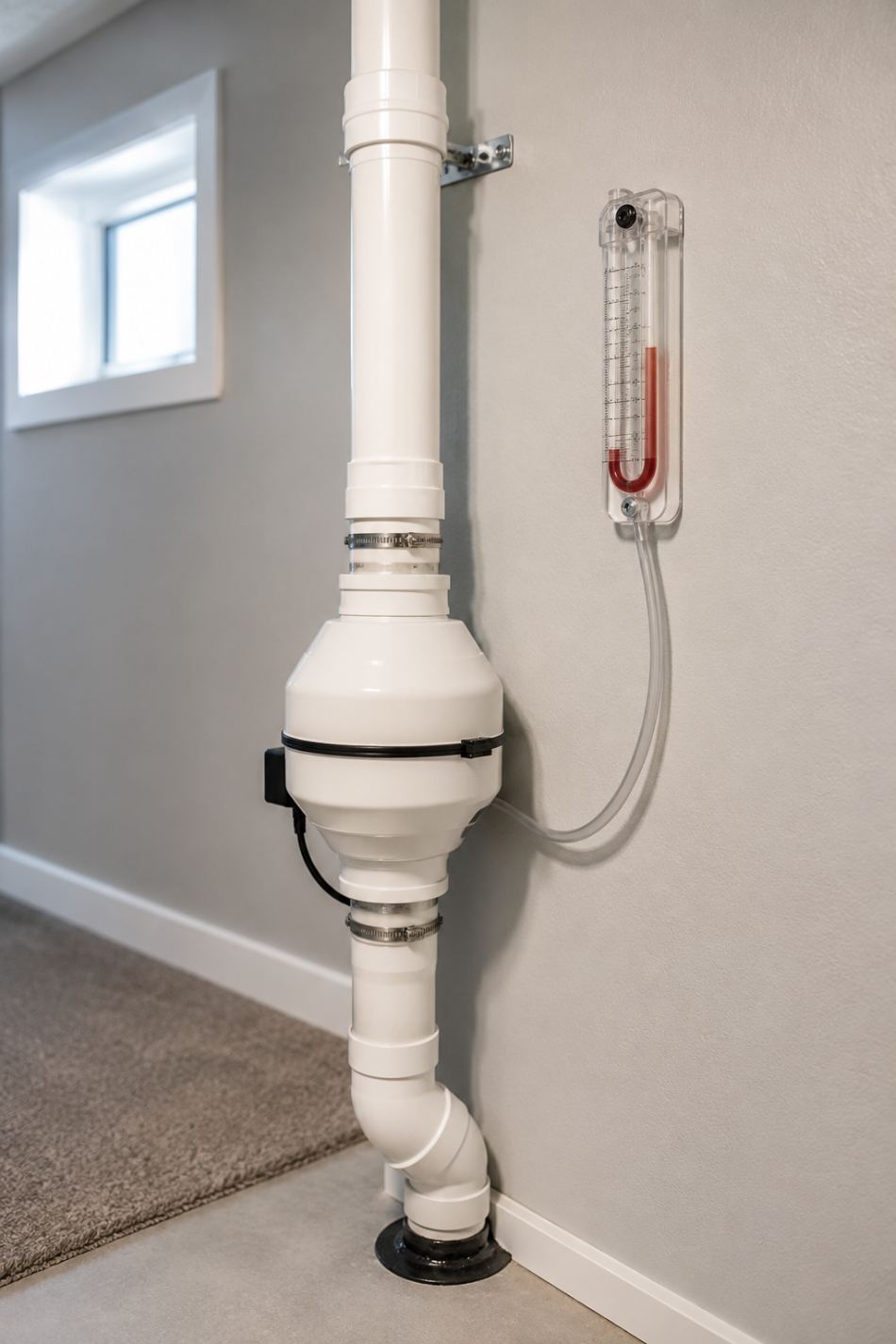
Installed radon mitigation system on a finished basement wall — sealed white PVC pipe, inline fan, and a U-tube manometer

A proper install in a valley home looks like this:

  • Diagnostics first. We check how air actually moves under your slab — called a communication test. In rocky mountain soils this step is the difference between a system that works and one that just hums.
  • Suction point and sealed piping. A suction cavity below the slab (or the sump pit, when the home has drain tile), connected to sealed PVC routed through the interior and attic where possible — which keeps pipe off your siding — or painted to match on a rear elevation.
  • The fan, outside living space. Code puts the inline fan in the attic, garage, or outdoors — never in the basement — so any leak on the pressure side stays out of your air.
  • A manometer you can read. The small U-shaped gauge on the pipe shows system vacuum at a glance. If the fluid ever levels out, the fan has stopped — call us.
  • Verification testing. Every install ends with a 48-hour post-mitigation test. You get a number, not a promise. Mitigated homes typically land under 2 pCi/L, often under 1.

Done right, the system is about as loud as a refrigerator and costs roughly $60–$120 a year in electricity to run continuously. Where a run passes near bedrooms, we use quieter EC fans and vibration couplings — in a home you paid Aspen prices for, the system should be something you forget exists.

Why Mountain Homes Are Different

Front Range tract homes mostly sit on one simple slab. Roaring Fork Valley homes don't. Hillside lots produce walkout basements with uneven pressure below grade; decades of additions leave one house with a basement and a crawlspace and slab-on-grade sections; and modern Aspen construction is sealed tight for energy efficiency, which — counterintuitively — often traps more radon than an old drafty house ever held. High-altitude winters make it worse: a 7-month heating season drives the stack effect that pulls soil gas indoors, exactly when every window is shut.
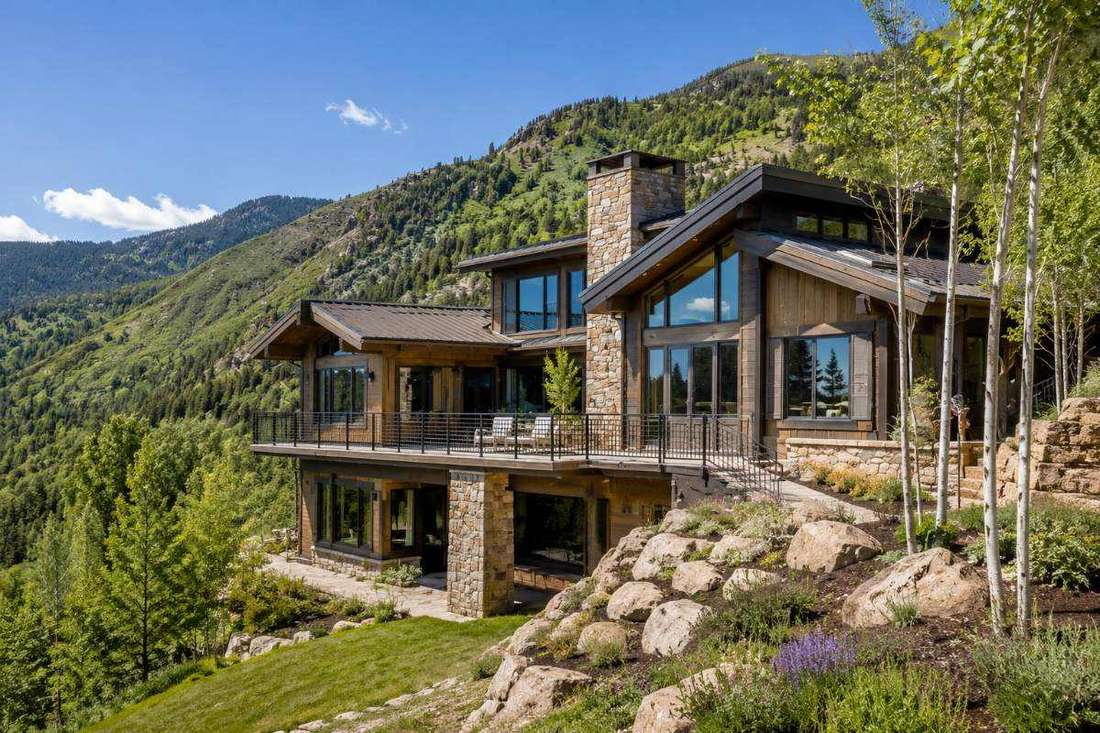
Hillside Aspen-area home with a walkout lower level, mountains behind
Mixed foundations and walkout basements are the norm on valley lots — one reason mountain systems get engineered, not templated.

That's why quotes here can run above the numbers you'll read on national cost sites, and why we design multi-point systems for mixed foundations rather than forcing a one-slab solution onto a three-foundation home. If your lower level is finished — most in Aspen are — routing and aesthetics get engineered in from the start, not patched after.

Test First. It Might Cost You Nothing.

Here's something a radon company probably shouldn't lead with: you may not need to pay anyone to find out where you stand. The City of Aspen hands out free test kits year-round at City Hall, Pitkin County offers them every January, and Garfield and Eagle counties run their own programs. If a kit comes back low, wonderful — retest in a couple of years, and sooner if you renovate.

Where we come in: results near or above 4.0 pCi/L, conflicting numbers, real-estate deadlines that need a licensed measurement professional's continuous-monitor test, or a home that needs a fix. We'd rather earn the mitigation job honestly than scare anyone into a test they could have gotten free.

Licensed — and You Can Check

Since July 1, 2022, Colorado law (HB21-1195) requires anyone offering radon measurement or mitigation services to hold a state license through DORA, built on national NRPP certification. That was a good day for homeowners: it ended the era of anyone-with-a-drill radon work. Verify any radon contractor — including us — through DORA's public Check a License lookup before you hire. If a bid lands in your inbox from someone who isn't licensed, that's your answer.

From Aspen to Glenwood Springs

We serve the full CO-82 corridor and the Crystal River Valley: Aspen — the West End, Red Mountain, Smuggler, Starwood, East Aspen, and McLain Flats — plus Snowmass Village, Old Snowmass, Woody Creek, Basalt, El Jebel, Carbondale, Redstone, and Glenwood Springs. Homes on wells in McLain Flats and Old Snowmass: ask about radon in well water — it's a real thing here.
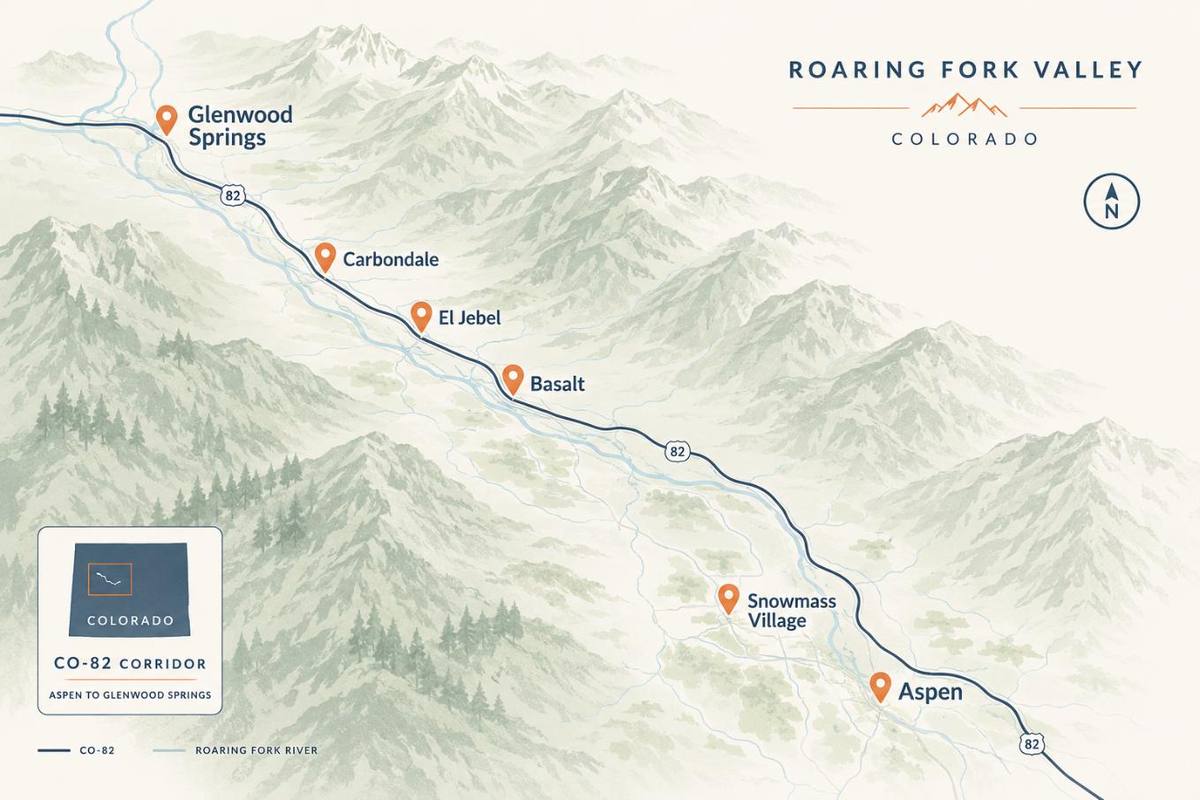
Illustrated service-area map of the CO-82 corridor from Aspen to Glenwood Springs, with pins on each town served
Serving the Roaring Fork & Crystal River valleys, Aspen to Glenwood Springs.

Get Your Radon Number Handled

Straight answers, licensed work, and a verification test that proves it.

(970) 315-9807

Radon Questions, Answered Straight

Is radon actually a real problem, or is this something inspectors sell?

It's real, and the science doesn't come from the mitigation industry — it comes from decades of studies of uranium miners and residential case-control research. Radon is the #1 cause of lung cancer in non-smokers. The reason it feels like a scam is that you can't see, smell, or feel it, and nothing happens short-term. The honest check: test with a free county kit. If your number's low, you owe nobody anything.

My test came back 3.9 — the EPA limit is 4.0, so I'm fine, right?

There's no bright line at 4.0 and no "safe" level — risk scales with exposure, and living at 4.0 is roughly comparable to a couple hundred chest X-rays a year. The EPA says fix at 4.0 and consider fixing between 2 and 4; the WHO draws its line at 2.7. A 3.9 in summer is also very often a 6 in January, because winter is when radon peaks here. We'd retest in heating season before celebrating.

What's the process and how long does an install take?

Most single-foundation systems are installed in a day: diagnostics, suction point, sealed pipe run, fan outside the living space, manometer, and then a 48-hour verification test to prove the number dropped. Complex mixed-foundation homes can take longer — we'll tell you exactly what yours needs after diagnostics.

Will a radon system hurt my home's resale value?

The opposite, usually. Under Colorado's disclosure law (SB23-206), sellers must disclose known radon results to buyers. An unmitigated high test in your disclosure file is a negotiation problem; a documented system with a verified low number is a selling point. Buyers' agents in this valley know exactly what that manometer means.

Why did my radon double in the winter?

Snow-covered frozen ground blocks soil gas from escaping outdoors, your sealed house plus rising heated air (the stack effect) actively pulls it in, and the heating season here runs seven-plus months. Winter numbers are your real exposure — which is why Aspen and the state health department both recommend testing in winter.

My neighbor tested low. Do I really need to test?

Neighbor results predict nothing — identical adjacent homes routinely differ several-fold. Foundation type, slab cracks, sump pits, HVAC pressure balance, and rock fractures at the scale of meters all change the answer. Testing your own house is the only way to know, and the kit can be free.

Can I just crack a basement window or run an air purifier?

No. Radon is a gas, so HEPA purifiers do nothing for it, and an open window only works while it's open — not an option in a Rocky Mountain winter, which is exactly when levels peak. Mitigation works by stopping soil gas below the house, not by diluting it after it's inside.

How much does mitigation cost in the Aspen area?

Most Colorado systems run roughly $1,200–$3,000 installed. Complex mountain homes — mixed foundations, finished lower levels, rocky sub-slab conditions — can run more. We wrote the most detailed cost breakdown in the valley: see our radon mitigation cost guide.

Does a vacant second home build up dangerous radon while we're away?

Radon doesn't accumulate forever — levels reach steady state about 12 hours after a home is closed up. The real vacant-home problem is testing done wrong: a caretaker airs the place out, then tests, and the result is meaningless. See second homes & property managers for the right protocol.

How do I know you're legit?

Look us up. Colorado requires every radon measurement and mitigation professional to hold a DORA license (HB21-1195, since July 2022). Search DORA's "Check a License" tool for any contractor you're considering — including us. Licensing plus a post-install verification test means you never have to take anyone's word for anything.

Start With the Guide That Fits Your Situation

Buying or selling? Read radon in real-estate deals. Budgeting? The cost guide. Just got a high number? How mitigation systems work. Curious about the local picture? Radon levels in Aspen & the valley.

Tap to Call — (970) 315-9807