Radon fans last 10–15 years, and when one dies your system is off — no suction, no protection, usually no warning beyond a manometer that's leveled out. We replace fans ($300–$600), repair badly built systems, and retest so you know the fix worked.
Call (970) 315-9807Tell us about your home and a licensed pro will get right back to you — usually the same day. Prefer to talk it through? Call (970) 315-9807.
The fan is the only moving part in a radon system, and it runs 24 hours a day for its entire life — so a 10–15 year lifespan is the realistic expectation, not a defect. If your system went in when you bought the house twelve years ago, it's in the retirement window right now. Replacement typically runs $300–$600, which covers the new fan, swapping it into the existing pipe run, and confirming the system pulls proper vacuum afterward. Compare that to $1,200–$3,000 for a full install and the math is friendly: the expensive parts of your system — the suction point, sealed pipe run, and roofline vent — don't wear out. Only the fan does.
Sometimes a dying fan gives notice: new grinding, rattling, or humming from a unit that used to be silent means bearings on their way out. Replace it on your schedule instead of discovering a dead system at your next retest — or during a buyer's inspection.
If the two fluid columns in your manometer are sitting level with each other, your system has no suction — the fan has failed, lost power, or the pipe is blocked. That U-shaped tube on your radon pipe shows the vacuum the fan creates; unequal columns mean working, level columns mean off. The system doesn't beep or flash when this happens. It just quietly stops protecting the house, and radon returns to whatever your pre-mitigation level was.
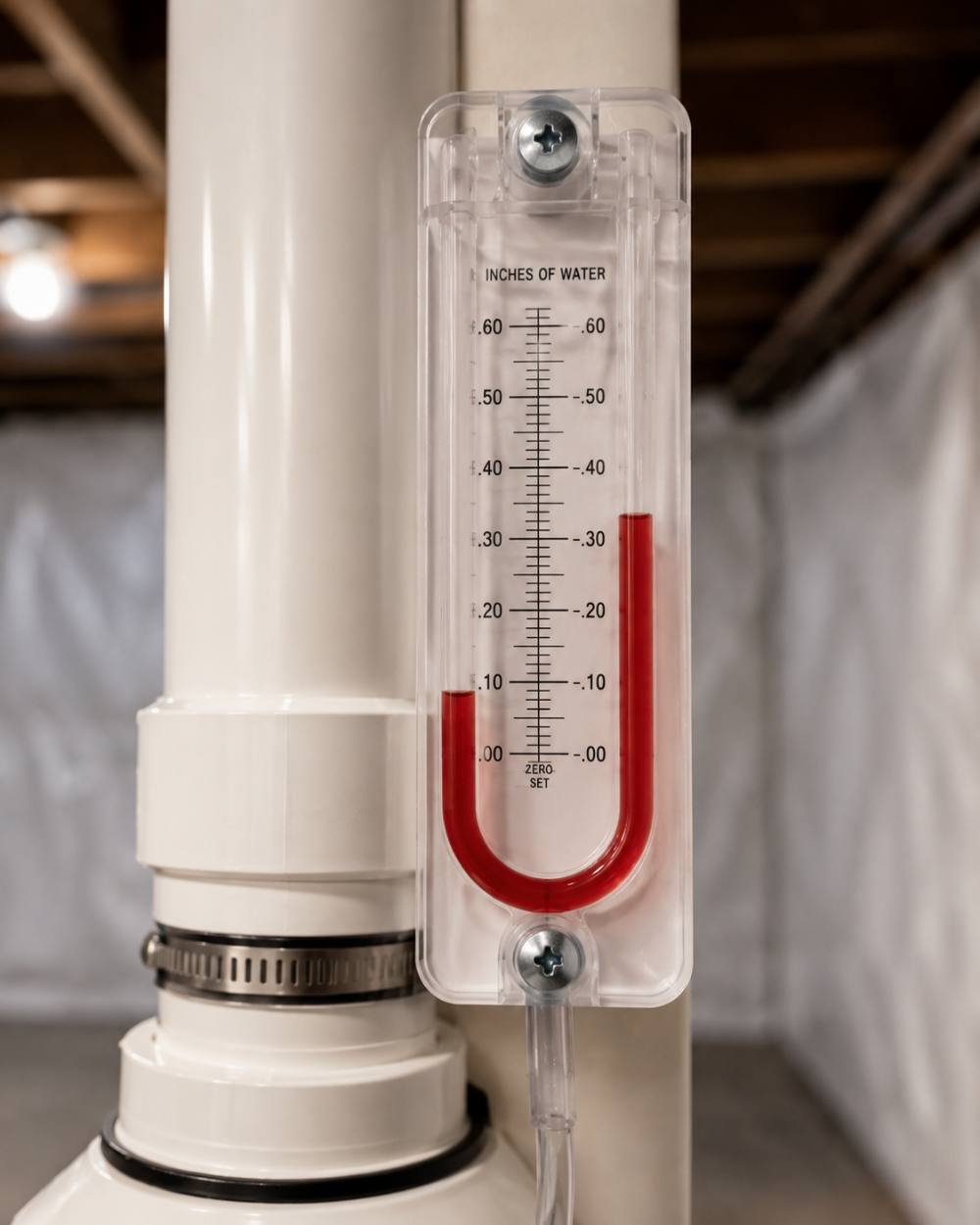
Two quick checks before you call: make sure a breaker didn't trip or a switch near the fan didn't get bumped, and listen near the fan for the usual faint hum. Power's on but the gauge is flat? That's a fan replacement. We stock common fans, and the swap plus a vacuum check is a short visit. Make the manometer glance a monthly habit — it's the only monitoring a radon system asks of you.
An existing radon system is a plus, not a red flag. It means the radon question was already answered honestly — a previous owner tested, found the number, and paid to fix it — and under Colorado's disclosure law (SB23-206) you're entitled to the records: prior test results, mitigation details, the paper trail. A documented system with a verified low number is worth more than a neighboring house that's simply never been tested.
The caveat: verify it works before you rely on it. A pre-purchase system inspection covers the manometer reading, fan condition and age, pipe routing and sealing, whether the fan sits outside the living space and the vent terminates above the roofline, and — the part that actually matters — a current radon test, because the manometer proves suction, not low radon. If the fan is a 13-year-old original, budget the $300–$600 swap and negotiate accordingly. Mid-transaction? See radon in real-estate deals for how systems play at the negotiating table.
Fast fan swaps and honest system inspections — retested so you know it worked.
(970) 315-9807The manometer tells you the fan is pulling vacuum; only a radon test tells you the house is actually low. Retest every two years even when the gauge looks perfect, and sooner after renovations, basement finishing, or HVAC changes — new slab cracks and pressure changes can open pathways the original system wasn't designed to cover. A two-year retest costs little (county kits are often free — see radon testing), and it's the difference between assuming your system works and knowing it does. If the retest creeps up while the manometer still shows suction, that's a repair call, not a mystery: something changed in the house, and the system needs to catch up.
Some systems don't need a new fan — they need corrections, because they were built badly the first time. Since July 2022, Colorado law (HB21-1195) has required radon mitigation professionals to hold a DORA license, but plenty of running systems predate that era. The red flags we correct most often:
If any of that describes the system you have — or the system in the house you're buying — a repair visit brings it up to standard for far less than a new install, and it ends the same way every job of ours does: with a verification test and a number.
Check the manometer — the small U-shaped tube of colored fluid on the system pipe. If the two fluid columns are level with each other, there's no vacuum and the fan is off: failed, unplugged, or on a tripped breaker. A fan that's newly grinding or rattling is announcing bearing failure in advance. Check power first; if power's fine and the gauge is flat, it's a $300–$600 replacement, and we retest after the swap.
Good — an existing system is a plus, not a red flag. It means the question was answered and fixed, and Colorado's disclosure law entitles you to the records: past tests, system details. What you shouldn't do is take it on faith. Get a system inspection (manometer, fan age, routing, fan location, vent height) plus a current radon test, because suction on the gauge doesn't guarantee a low number. If the fan is near the end of its 10–15 year life, that's a $300–$600 negotiating item, not a deal problem.
Typically 10–15 years of continuous, 24/7 operation. Nothing you do shortens or extends that much — it's simply a motor's working life. Replacement runs $300–$600 and reuses your existing pipe, suction point, and vent. While it runs, a fan costs roughly $60–$120 a year in electricity. If yours is past year ten, a monthly manometer glance is cheap insurance; if it's past fifteen and original, replacing proactively beats finding out at a buyer's inspection.
Wondering what a whole new system costs? The Colorado cost guide. How systems work in the first place: mitigation systems. Due for your two-year check: radon testing. Under contract on a house with (or without) a system: real-estate radon.