How Sub-Slab Depressurization Works
A radon system doesn't filter the air in your house — it intercepts soil gas below the house, before it ever gets in. That's the whole trick, and it's why sub-slab depressurization (SSD) has been the standard fix for decades.
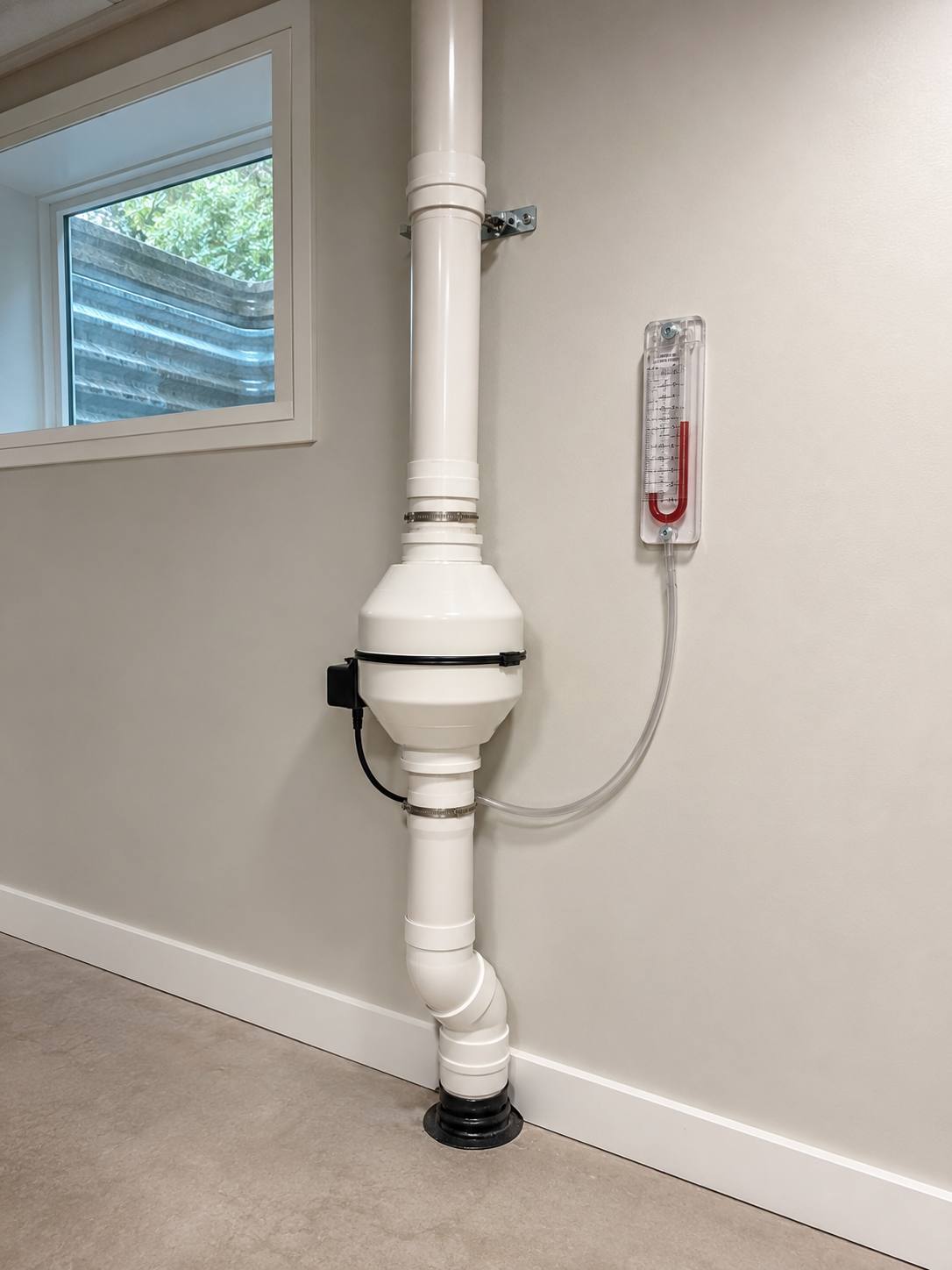
Radon enters because your home is slightly depressurized relative to the soil beneath it — heated air rises and leaks out up high, and replacement air gets pulled in down low, through slab cracks, joints, and penetrations, carrying soil gas with it. An SSD system reverses that contest. A pipe is set into a small suction cavity beneath the slab, and an inline fan runs continuously, creating a gentle vacuum in the soil under your foundation. Soil gas that used to drift up through the concrete now takes the easier path: into the pipe, up through the house or along an exterior wall, and out above the roofline, where it disperses to background levels. The vent terminates above the roof specifically so the gas can't re-enter through windows or eaves.
The result isn't a marginal improvement. Homes that tested at 8, 15, or 30 pCi/L typically land under 2 after mitigation, often under 1 — and stay there for as long as the fan runs.
Sump-Pit and Drain-Tile Systems
If your home has a sump pit, it may already contain the best suction point in the house. Sump pits usually connect to perimeter drain tile — a loop of perforated pipe that already reaches under or around the entire footprint. Sealing the pit with an airtight lid and drawing suction from it turns that drainage network into a ready-made radon collection system, often with better coverage than a single drilled suction point. The sump pump keeps doing its job under the sealed lid; we just stop the pit from acting as an open radon chimney into your basement. Homes with drain tile but no sump can often tap the drain loop directly. Which approach fits your home falls out of the diagnostic visit — it's a measurement question, not a guess.
What a Proper Install Looks Like, Step by Step
Every system we install follows the same sequence, and each step exists because skipping it is how bad systems get built:
- Diagnostics and design. We assess your foundation type, slab condition, and routing options before quoting hardware.
- Sub-slab communication test. Before committing to a suction-point location, we verify that vacuum applied at that spot actually reaches across the sub-slab area. In the rocky, variable soils under mountain homes this is the make-or-break step — a suction point that only depressurizes three feet of gravel produces a system that hums and accomplishes nothing.
- Sealed PVC run. Schedule-40 PVC with sealed joints, routed for the least visual impact available in your home.
- Fan outside the living space. Code requires the inline fan to sit in an attic, garage, or outdoors — never in a basement or living area — so that any leak on the fan's pressure side leaks outside your air, not into it.
- U-tube manometer. A simple gauge mounted on the pipe that shows, at a glance, that the system is pulling vacuum.
- 48-hour verification test. After the system runs, we test. You get a post-mitigation number, not a handshake and a hope.
Routing and Aesthetics: Built for Aspen, Not Just to Code
You should not have to trade your home's appearance for safe air, and in this valley — where design review boards and HOAs take exteriors seriously — you shouldn't have to explain a white pipe on your front elevation either. Our first choice is interior routing: up through a closet, chase, or garage and out through the attic, so the only visible evidence is a short vent stack at the roof, no different from a plumbing vent. Where interior routing isn't practical, exterior runs go on rear elevations, out of view from the street, with pipe and fan housing painted to match your siding. On design-review-sensitive homes, tell us early — routing is a design decision we make with you at the diagnostic stage, not an apology after the fact.