Last updated
Last updated July 2026 — figures reflect current Colorado market ranges.
The Short Answer
Most Colorado radon mitigation systems cost roughly $1,200–$3,000 installed, with the most common jobs landing around $1,500–$2,000 — the Denver-area average sits near $2,000. Complex mountain homes run more: multiple foundation footprints, finished lower levels, and rocky sub-slab conditions all push the number up. That's the honest headline. Everything below explains what moves a specific house up or down inside — or beyond — that range.
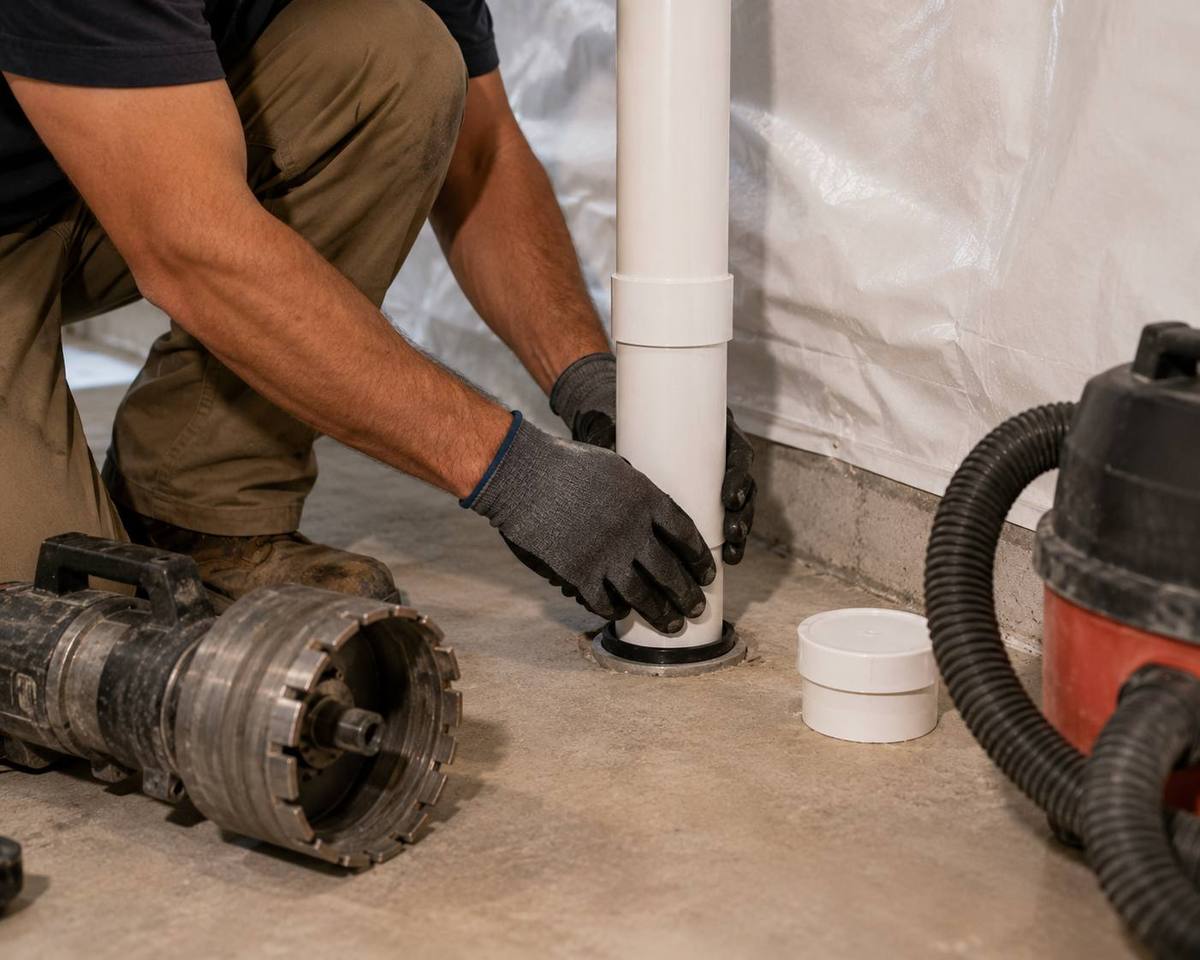
One framing worth keeping in mind: a mitigation system is a one-time fix for a permanent condition. The gas comes from the uranium-bearing rock and soil under the house, and it isn't going anywhere. Once installed, a system runs for years on a fan that costs about as much electricity as a light bulb.
Cost by System Type
The system your home needs is dictated by what it sits on, not by what's cheapest. Here's how the four common configurations price out:
- Standard sub-slab depressurization (SSD). The workhorse. One suction point cored through the basement or slab floor, sealed PVC to a fan outside the living space, vent above the roofline. For a single, reasonably porous slab, this is the low end of the range — roughly $1,200–$2,000 in most of Colorado.
- Sump-pit / drain-tile systems. If your home has a sump pit connected to perimeter drain tile, that network can become the suction field — often excellent coverage without extra suction points. The pit gets a sealed lid; pricing usually lands in the same territory as standard SSD.
- Crawlspace sub-membrane systems. Dirt-floor crawlspaces can't be depressurized directly, so a heavy-duty membrane is sealed across the floor and up the walls, and the system draws from beneath it. Materials and labor scale with square footage, so expect $2,000–$5,000+, with full encapsulation of a large crawl at the top of that range.
- Multi-point and combined systems. Basement plus crawlspace plus a slab-on-grade addition — one house, three foundations. Extremely common in hillside and walkout construction here. Each zone may need its own suction point or membrane, sometimes sharing one fan, sometimes not. These are quoted per home, and they're the main reason valley quotes can exceed what national cost articles predict.
| System type | Typical Colorado range | Best fit |
|---|---|---|
| Standard sub-slab depressurization | $1,200–$2,000 | Single basement or slab foundation |
| Sump-pit / drain-tile system | $1,200–$2,000 | Homes with a sump pit and perimeter drain tile |
| Crawlspace sub-membrane | $2,000–$5,000+ | Dirt-floor crawlspaces; full encapsulation at the top end |
| Multi-point / combined system | Quoted per home | Mixed basement + crawl + slab mountain homes |
Cost by Foundation and Home Factors
Two homes with the same square footage can be very different jobs. The factors that actually move the price:
- Finished lower level. Most Aspen-area lower levels are finished living space. Routing pipe through finished rooms means careful placement, closet or chase runs, drywall patching, and paint — more labor than an unfinished mechanical room ever needs.
- Sub-slab communication. A fan can only pull air the soil will give it. Rocky, compacted mountain fill often communicates poorly, which can mean a second suction point, a larger suction cavity, or a higher-capacity fan. This is why we run a communication test during diagnostics instead of guessing.
- Walkouts and hillside foundations. A walkout basement sits at grade on one side and below it on the other, creating uneven pressure below the slab. Suction-point placement matters more, and mixed-depth footprints frequently need multi-point designs.
- Routing choices. An exterior run up a rear elevation is the cheapest path. Interior-and-attic routing — which hides the pipe entirely, a real consideration for design-review-sensitive Aspen homes — costs more in labor. Painted exterior pipe splits the difference.
- Home size and footprint count. A 6,000-square-foot home on three foundation sections simply has more ground to treat than a 1,800-square-foot ranch on one slab. Fan sizing, pipe length, and suction points all scale.
Why Two Quotes for the Same House Can Differ by $2,000
It happens constantly, and it isn't always someone padding the bill. The usual reasons:
- One bid diagnosed, the other assumed. A contractor who ran a communication test and found tight sub-slab material bids two suction points; one who eyeballed it bids one. If the single-point system fails to bring your number down, the "cheap" bid gets expensive.
- Different routing. Hidden attic routing versus a pipe strapped to the side of the house can alone account for a four-figure spread.
- Different scope. Does the bid include sealing major slab cracks and the sump lid? A quiet EC fan or a builder-grade one? A 48-hour post-mitigation verification test, or "call us if you think it's not working"?
- Licensing and insurance. Colorado requires a DORA license for mitigation work (HB21-1195). A licensed, insured professional carries real costs an unlicensed handyman doesn't — and only one of them is legal to hire for this.
When you compare bids, compare the design, not just the total: suction points, fan model and location, routing, sealing scope, and whether verification testing is included. A quote that specifies all five is a quote you can trust — or challenge.
What It Costs to Run — Ongoing Costs
The fan runs continuously, and that's by design. Ongoing costs are modest and predictable:
- Electricity: radon fans draw about 60–85 watts, which works out to roughly $60–$120 per year at typical rates.
- Conditioned-air loss: the system pulls a small amount of heated air from the house along with the soil gas — figure a few dollars a month during the heating season.
- Fan replacement: fans last about 10–15 years and cost $300–$600 to replace. The u-tube manometer on the pipe tells you when: if the fluid levels out, the fan has stopped. See fan replacement & repair.
Total lifetime math: a $2,000 system plus roughly $100 a year to run is one of the cheaper permanent fixes a house can get — compare it to a roof, a boiler, or a single season of property taxes here.
What Testing Costs (Sometimes Nothing)
Before anyone quotes you a system, you need a number. Your options, cheapest first:
- Free county kits. The City of Aspen hands out free test kits year-round at City Hall; Pitkin County offers them every January; Garfield and Eagle counties run their own free-kit programs, and CDPHE mails one free kit per household per year.
- DIY kits, retail: $10–$30 at the hardware store.
- Professional testing: $125–$400 for a continuous-monitor test run by a licensed measurement professional — required in practice for real-estate transactions, and the right call when DIY results conflict.
Financial Help for Colorado Homeowners
If cost is the barrier between your family and a fix, three programs are worth knowing:
- CDPHE LIRMA: the state's low-income radon mitigation assistance program pays for mitigation for qualifying low-income homeowners with results at or above 4.0 pCi/L.
- City of Aspen APCHA pilot grant: a pilot mitigation grant program for APCHA homeowners — funding cycles vary, so check with the city's air quality office for current status.
- Walking Mountains rebates (Eagle County side): Basalt and El Jebel homeowners can pursue mitigation rebates through Walking Mountains Science Center; a Home Energy Assessment is the entry point (970-328-8777).
Who Pays in a Real-Estate Deal
If your quote exists because of an inspection, the cost question is really a negotiation question. The three standard outcomes in Colorado transactions: the seller installs the system before closing, the seller gives the buyer a closing credit of roughly $1,200–$2,000, or the buyer takes it on post-close (often in exchange for a concession elsewhere). None of these should sink a deal — radon is the most fixable finding in an inspection report. The full playbook is on our real-estate radon page.
What a Quote From Us Looks Like
Diagnostics first, then a written design: suction points, fan model and location, routing, sealing scope, and the 48-hour verification test — included, always, because you should get a number, not a promise. Call with your test result and we'll tell you over the phone roughly where your home is likely to land, and what would change that estimate.