Radon Testing in Aspen & the Roaring Fork Valley

Roughly 40–50% of homes tested in the Aspen area come back above the EPA action level. A professional continuous-monitor test gives you an hour-by-hour answer you can act on — and if a free county kit is all your situation needs, we'll tell you that too.

Call (970) 315-9807
Or get a free quote in 60 seconds
Colorado-Licensed (HB21-1195)
Continuous Radon Monitors
Real-Estate Deadline Ready
Aspen to Glenwood Springs

Get a Fast, Free Quote

Tell us about your home and a licensed pro will get right back to you — usually the same day. Prefer to talk it through? Call (970) 315-9807.

  • Straight answers first — we'll point you to a free county kit if that's all you need
  • A 48-hour verification test included on every install
  • Scheduling that works around real-estate objection deadlines

Professional Tests vs. DIY Kits: Which Do You Actually Need?

For a first look at a home you already own with no deadline attached, a DIY kit is genuinely fine — and around here it's often free. For a real-estate transaction, a disputed result, or a decision you're about to spend $1,500–$3,000 on, a professional continuous-monitor test is the right tool.

A charcoal kit gives you one averaged number for the test window. A continuous radon monitor (CRM) records levels hour by hour, which is why professionals use it: it shows whether your radon holds steady at 5, or lives at 2 and spikes to 12 overnight when the house buttons up. It also timestamps the data, so if a door was propped open halfway through a real-estate test, the record shows it. Professional tests in Colorado typically run $125–$400; DIY kits are $10–$30 retail, and continuous monitors you can buy yourself run about $150–$230.
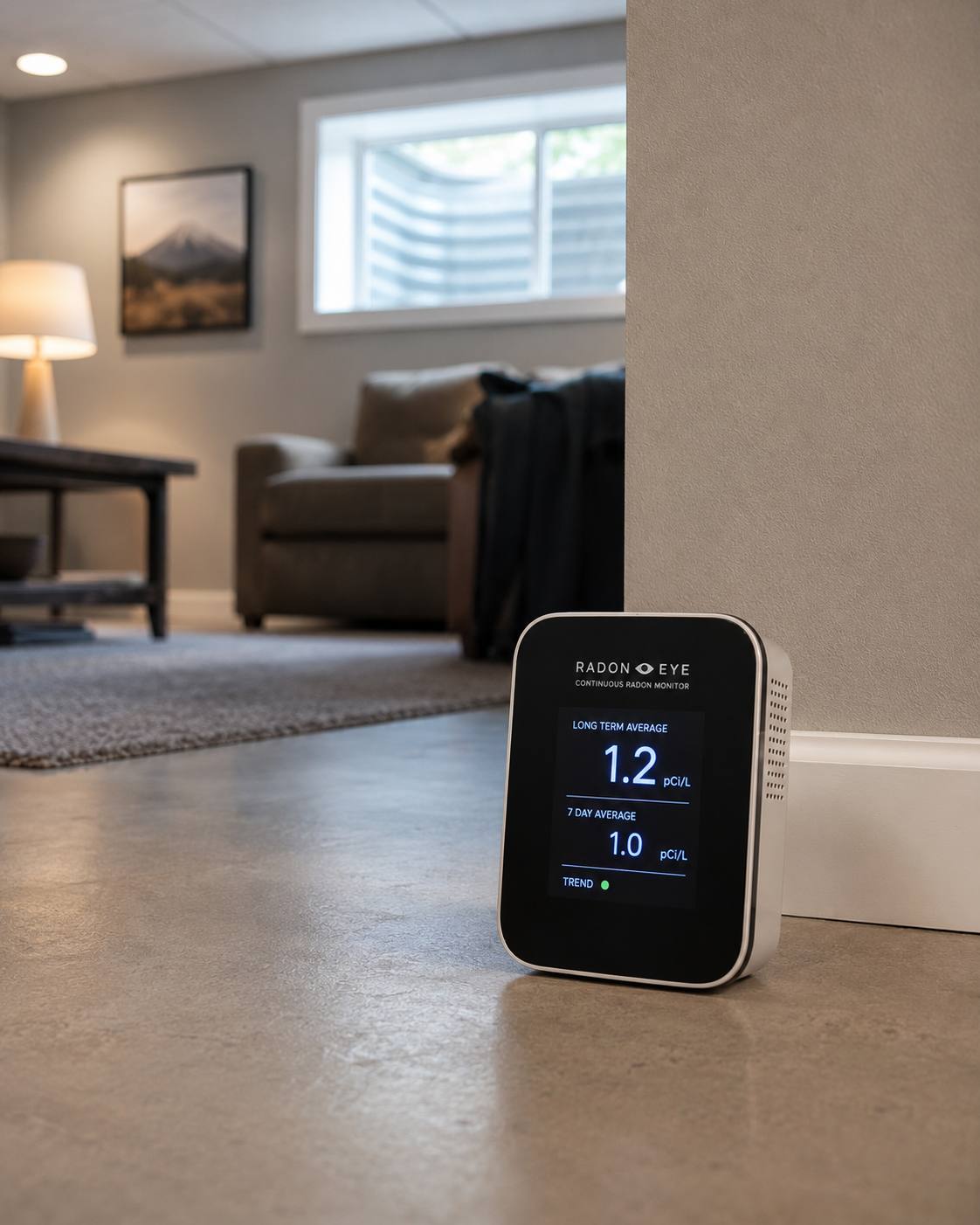
A professional continuous radon monitor displaying a low pCi/L reading on a finished basement floor
A continuous radon monitor records levels hour by hour — the tool professionals test with.

First, the Free Options — Seriously

Before you pay anyone, including us: every county in this valley gives away radon test kits, and if a free kit answers your question, use it. We'd rather you test free and call us only if the number is high.

Where a paid test earns its fee: transactions on a deadline, results near the action level, conflicting numbers, verifying a mitigation system, or any situation where an hour-by-hour record matters more than a single average.

The Closed-House Protocol: Why 12 Hours Matters

Every short-term radon test — free kit or $400 professional CRM — requires windows and exterior doors closed for 12 hours before the test starts and for its entire duration. This is the EPA's closed-house protocol, and skipping it is the single most common way valley homes get a falsely low result.

The 12-hour figure isn't arbitrary. Radon has a half-life of 3.8 days, and indoor levels reach steady state roughly 12 hours after a home is closed up. Air the house out the morning of your test and you're measuring fresh mountain air, not your home. This is especially common with second homes here: a caretaker opens everything up before guests arrive, someone drops a kit on the counter, and the "reassuring" result is meaningless. Normal coming and going through doors is fine — it's open windows and whole-house airing that invalidate the test.

Winter Is the Worst Case — So Winter Is When to Test

Radon peaks in winter, which means a winter test measures your real exposure and a July test measures your best case. Three things stack up in a Roaring Fork Valley winter: frozen, snow-covered ground blocks soil gas from venting outdoors, so more of it follows the path of least resistance — under your slab. Your sealed, heated house creates the stack effect: warm air rising and escaping up high pulls replacement air in down low, straight from the soil. And the heating season here runs seven-plus months, so this isn't a brief seasonal blip — it's most of the year. Both the City of Aspen and the state health department recommend testing in winter for exactly this reason. If your only data point is a summer reading of 3.2, treat it as a floor, not an answer.

Need a Number You Can Rely On?

Licensed continuous-monitor testing, scheduled around your deadline.

(970) 315-9807

Buying or Selling? The Test Must Be Done by a Licensed Professional

If a radon test is part of a real-estate transaction in Colorado, the person performing it must hold a state radon measurement license. That's HB21-1195, in effect since July 1, 2022: anyone offering radon measurement or mitigation services professionally needs a DORA license built on national NRPP certification. Homeowners can still self-test their own homes — but a DIY kit result generally won't carry weight in a transaction, and it shouldn't.

For deals, the licensed CRM test is the standard for good reason: tamper-resistant, hourly data, a formal report both agents can rely on, and results available as soon as the monitor comes off the floor — no waiting on a lab. Colorado's disclosure law (SB23-206) also means every residential contract now carries a radon advisory and sellers must disclose known results, so the numbers in that report matter. If you're mid-transaction, mention your objection deadline when you call and we'll schedule around it. You can verify any measurement professional — including us — at DORA's Check a License lookup. More on the transaction side: radon in real-estate deals.

How Often Should You Retest?

Every two years, even after a low result — and sooner after anything that changes how your house breathes. Radon isn't a one-and-done measurement: levels shift as foundations settle, cracks open, and equipment changes. Retest after renovations (especially basement finishing or an addition), after HVAC changes (new furnace, air sealing, new ventilation), after energy-efficiency work that tightens the envelope, and two years after any clean test. If you have a mitigation system, the same two-year retest confirms it's still performing — the fan won't announce its own retirement.

Two Tests, Two Different Numbers — Now What?

Don't panic, and don't cherry-pick the low one. Radon varies by the hour, so two short-term tests taken at different times legitimately disagree. If both results are short-term, the standard guidance is to average them: a 3.1 and a 5.3 average to 4.2, which says "act." If the two numbers are far apart or the decision is expensive, the better move is more data, not a third coin flip — a long-term (90-day) test or a continuous monitor captures the swings a 48-hour snapshot misses. Season matters too: a summer 3.5 and a winter 6.0 aren't contradicting each other; they're both true. When a result sits near 4.0 or two tests won't agree, that's a good time to call — this is the exact problem hourly CRM data was built to solve.

Radon Testing Questions, Answered Straight

My test came back 3.9 — the EPA limit is 4.0, so I'm fine, right?

Not quite. There's no bright line at 4.0 and no "safe" radon level — risk scales linearly with exposure, and living at 4.0 is roughly comparable to a couple hundred chest X-rays a year. The EPA says fix at 4.0 and consider fixing between 2 and 4; the WHO sets its reference level at 2.7. And a 3.9 from a summer test is very often a 6 in January. We'd retest in heating season before filing that number under "done."

I ran two tests and they disagree. Which one do I believe?

Both — radon genuinely swings hour to hour and season to season. For two short-term tests, average them and act on the average. If they're far apart, or you're about to make a $2,000 decision, get better data instead of a tiebreaker: a 90-day long-term test or a continuous monitor shows the pattern behind the snapshots. Also check the basics — was the house closed for 12 hours before each test, and were they run in the same season?

Does it matter if I test in winter vs. summer?

A lot. Winter is the worst case in the mountains: frozen, snow-covered ground pushes soil gas toward your foundation while the stack effect in a sealed, heated home pulls it in — for a heating season that runs seven-plus months here. A winter test measures your real exposure; a summer test measures your best case. If your low number came from July, treat it as a floor and retest in winter.

My neighbor tested low. Do I really need to test?

Yes — your neighbor's result predicts nothing about your house. Identical adjacent homes routinely differ several-fold because foundation type, slab cracks, sump pits, HVAC pressure balance, and rock fractures at the scale of meters all change the answer. The EPA zone maps are county-level predictions; even those get beaten by street-level reality. Your own test is the only answer, and around here the kit can be free.

How often should I retest my home?

Every two years, and sooner after renovations, HVAC changes, basement finishing, or air-sealing work — anything that changes how the house breathes changes how it draws soil gas. If you have a mitigation system, the two-year retest is also your proof it's still working, alongside a quick monthly glance at the manometer.

Related Guides

Test came back high? Here's how mitigation systems work and what they cost in Colorado. On a contract deadline? Radon in real-estate deals. Testing a vacant or second home? Second homes & property managers.

Tap to Call — (970) 315-9807