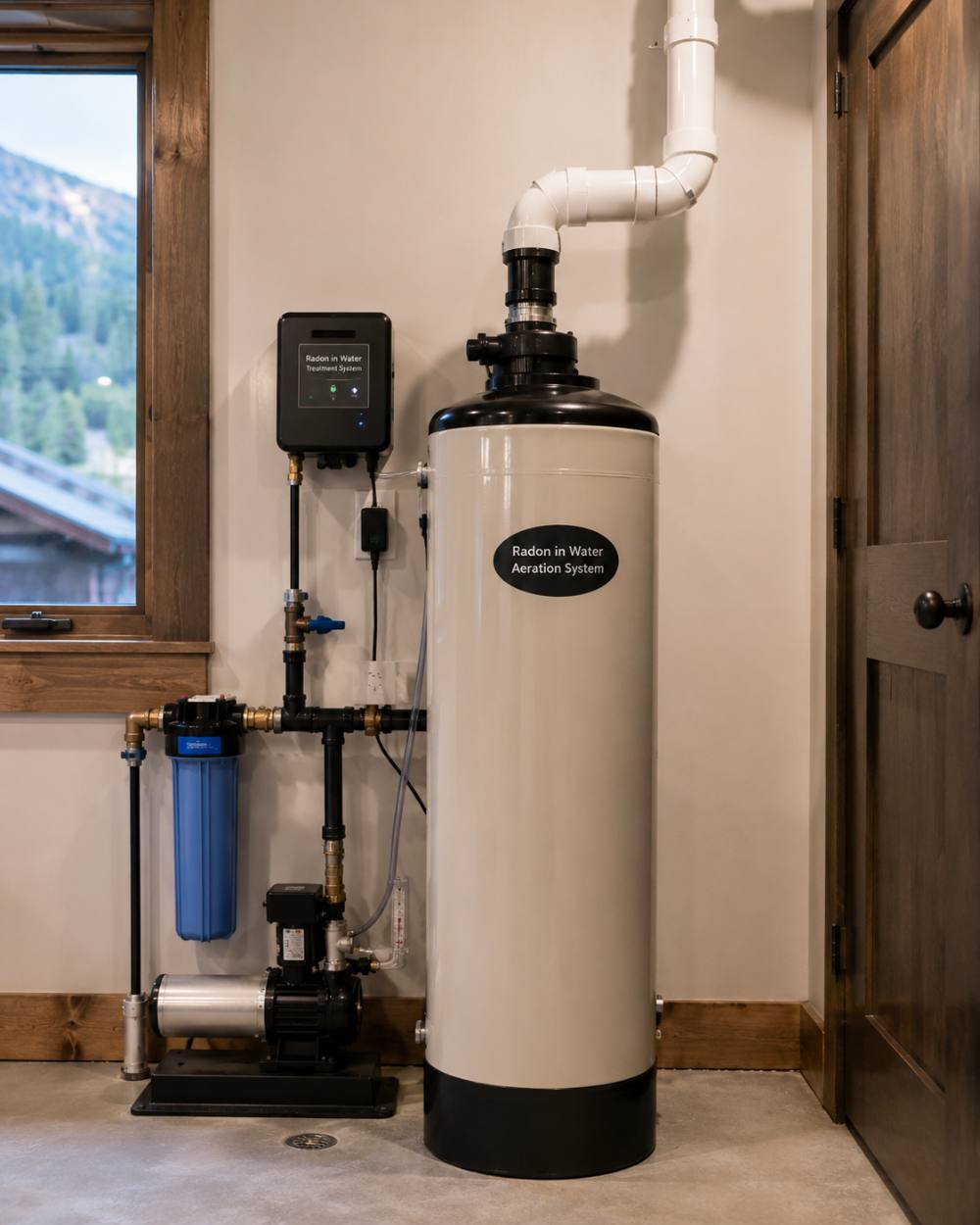
Yes, Radon Really Can Come Through Your Water
Groundwater moving through uranium-bearing rock picks up dissolved radon, and a private well delivers that water — radon included — straight to your taps. This isn't a theoretical mountain-town worry: a peer-reviewed study of a Colorado mountain community found that 100% of the 27 private wells tested exceeded the EPA's proposed radon limit for drinking water. Homes on municipal supplies largely skip this problem, because treatment and storage give the radon time and opportunity to escape before it reaches the house. Well homes get the water hours out of the rock.
How Water Radon Becomes Air Radon
The main risk isn't drinking the water — it's breathing what the water releases. Radon off-gasses from water when it's agitated or heated: showers, dishwashers, laundry, a running tap. Every hot shower is, in effect, a small radon-release event in the most enclosed room in the house. The working rule of thumb: 10,000 pCi/L of radon in water adds roughly 1 pCi/L to indoor air. That sounds like a steep exchange rate until you're a well home in high-radon rock, where water concentrations can climb far enough to matter — especially stacked on top of whatever soil gas is already contributing.
Who Should Test Their Water
Not everyone needs this test. The profile that does:
- Well homes whose air levels stay elevated after a soil-gas system is installed. This is the classic tell. If a properly built sub-slab system verified low and your levels later creep back up — or never fully came down — the water is the next suspect.
- Private-well owners in the valley's well country: McLain Flats — large parcels, mostly on wells — Old Snowmass, Woody Creek, and the Crystal River Valley south of Carbondale. If your water comes from your own hole in Rocky Mountain rock, a one-time water test is cheap certainty.
- Anyone with a very high air result on a well home. Knowing how much each pathway contributes changes what you build.
The sequencing matters: air first, water second. Soil gas is almost always the dominant source, so start with an air test (county kits are free), mitigate if needed, and test water when the numbers say the story isn't finished.
Fixing It: Aeration vs. GAC
Two established treatments, chosen by concentration:
- Aeration systems are the gold standard for meaningful water-radon levels. The unit bubbles air through incoming water in a tank, stripping out up to ~99% of the radon and venting it outdoors above the roofline before the water enters your plumbing. Installed cost typically runs $3,000–$6,000.
- Granular activated carbon (GAC) filters adsorb radon from the water stream and suit lower concentrations. They're cheaper up front, but the media loads up over time — including with radioactive decay products — so they need monitoring and periodic replacement, and they're the wrong tool for heavily loaded wells.
We'll tell you plainly which side of that line your test result falls on — and if the honest answer is "your water's fine, it's your slab," you'll hear that instead.
One House, One Plan
Radon in a well home is a two-pathway problem, and the fix should be designed as one system: measure air, measure water, attribute the sources, then build only what the numbers justify. That's cheaper than guessing twice.