Colorado's Baseline: About Half of Homes Test High
Start with the state. Colorado's health department (CDPHE) puts it bluntly: about half of Colorado homes have elevated radon. That's not a slogan — across roughly 237,000 tests CDPHE tracked from 2005 to 2025, 46.4% came back at or above the EPA action level of 4.0 pCi/L. Whatever the numbers say about our valley specifically, you're reading them against one of the highest-radon states in the country.
County by County: Pitkin, Garfield, Eagle
Pitkin County (Aspen, Snowmass Village, Woody Creek, Redstone) is designated EPA Zone 1 — the agency's highest-risk category, meaning predicted average indoor levels above 4.0 pCi/L. Local testing bears the designation out: county environmental health staff report that roughly 40–50% of homes tested in the Aspen area come back above the action level.
Garfield County (Carbondale, Glenwood Springs) is also EPA Zone 1, and the county government's own figure is that about 40% of tested homes exceed the limit.
Eagle County (Basalt's mid-valley side, El Jebel) is the interesting one. On the EPA map it's Zone 2 — moderate predicted risk. But actual test data tell a different story: roughly 40–45% of tested Eagle County homes exceed 4.0 pCi/L. In the Avon ZIP code 81620, 44.7% of 3,845 tests came back high. The lesson applies valley-wide: the EPA map is a prediction drawn at county scale; your test is the truth about your address.
Why This Valley Runs High: The Geology
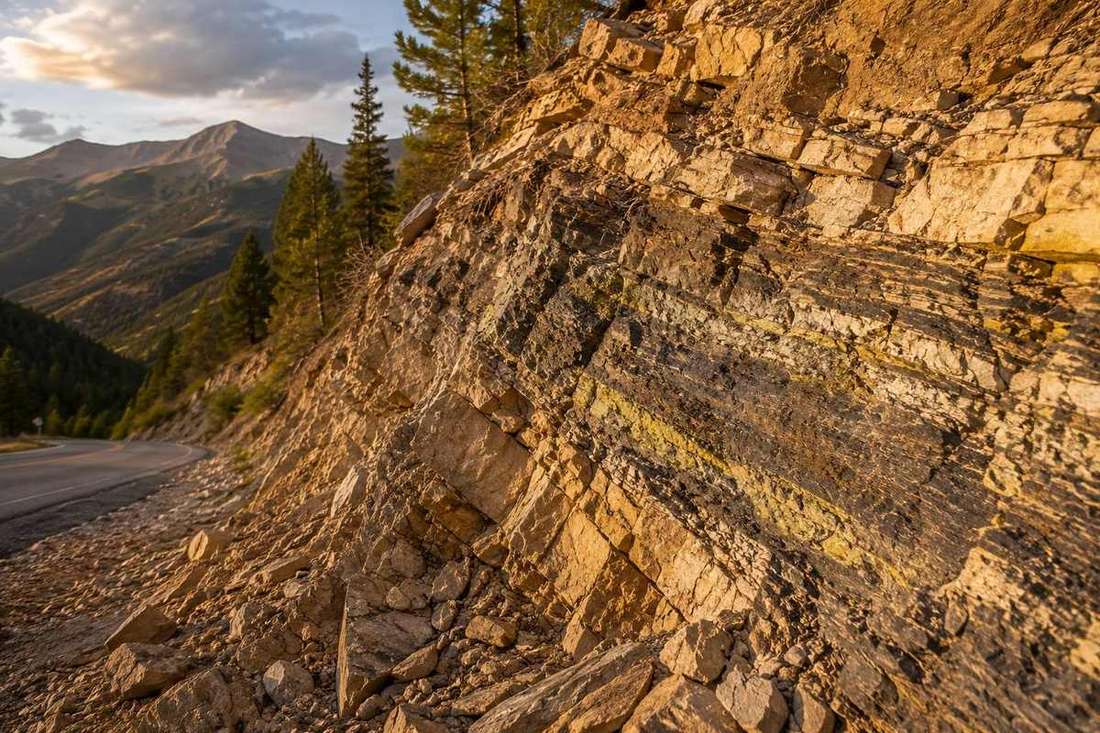
The Colorado Rockies are built, in many places, from uranium-bearing rock and soil — and radon is simply what uranium's decay chain produces on its way to lead. Two features make the mountains deliver it into houses efficiently, per the Colorado Geological Survey and Garfield County's environmental health program: the source rock is widespread rather than confined to a few hot spots, and fractured rock gives soil gas ready pathways to move toward the surface — and toward whatever foundation is sitting on it. That fracturing is also why radon is so hyper-local: a fracture network at the scale of meters can put one high home next to one low one, which is why a neighbor's result predicts nothing about yours.
Altitude, Winter, and the Stack Effect
Mountain living adds a seasonal multiplier. In winter, three things happen at once: heated air rises and leaks out of the top of the house, which pulls replacement air — including soil gas — up through the foundation (the stack effect); homes are sealed tight against the cold; and frozen, snow-covered ground blocks soil gas from venting harmlessly outdoors, leaving your basement as the path of least resistance. Our heating season runs seven-plus months, so this isn't a brief winter spike — it's the majority of the year. It's also why Aspen and CDPHE both recommend testing in winter: that's the number your family actually lives with.
Aspen Took This Seriously Before Anyone Else
If you're wondering whether local officials treat radon as real: Aspen was the first municipality in Colorado to put a radon requirement into its building code, back in 2003. More than 54 Colorado municipalities now require radon-ready new construction, and since December 2023 the state requires post-construction radon testing. Pitkin County, for its part, publishes public dot-maps of valley test results — you can see the pattern of high and low tests around your own neighborhood, from the West End to Red Mountain to McLain Flats.
Free Test Kits, County by County
Every county in the valley will help you get your number at no cost:
- City of Aspen: free kits year-round at Community Development, 1st floor of City Hall, 427 Rio Grande Place (airquality@aspen.gov, 970-920-5039).
- Pitkin County: free kits every January at 530 E Main St, Suite 205.
- Garfield County: free kits year-round in Glenwood Springs (2014 Blake Ave), Rifle, and via CLEER at the Third Street Center in Carbondale — kits can be mailed (970-665-6383).
- Eagle County (Basalt/El Jebel side): free kits including at the El Jebel Community Center, limit two per household per year.
- CDPHE: one free kit per household per year, statewide.
What This Means for Your Home
Put the pieces together: a state where nearly half of homes test high, two Zone 1 counties plus a Zone 2 county that tests like Zone 1, geology that varies house by house, and a seven-month season engineered to pull soil gas indoors. The statistics can't tell you whether your house is the 40–50% or the other half — only a test can, and around here the test is frequently free. If the number comes back low, retest in a couple of years. If it comes back high, it's a solved problem: see how mitigation works and what it costs.